Lithium-ion batteries are now embedded across modern mine sites, and operations are becoming increasingly reliant on battery-powered equipment.
Individual batteries may appear to present a relatively small risk. But when multiple batteries are being stored and charged across workshops, warehouses, maintenance areas, crib rooms and operational facilities, the exposure changes.
Without a consistent approach, sites can face:
Lithium-ion battery risks can include uncontrolled energy release, extreme heat, electrical hazards, chemical exposure and thermal runaway.
WorkSafe WA’s guidance for the mining industry identifies battery use, configuration and storage design as areas requiring consideration. It also identifies inadequate battery cabinet design, inadequate risk assessment, maintenance, training and safe systems of work among factors that can contribute to battery incidents.
The issue isn’t that mine sites suddenly started using batteries. It’s that the volume and importance of battery-powered equipment have changed significantly.
As operations continue to adopt rechargeable tools, equipment and technology, battery storage needs to evolve with them.
More batteries require better systems — not more workarounds. So, as battery use increases, leading HSE teams are beginning to ask a different question: Have our battery storage practices kept pace?
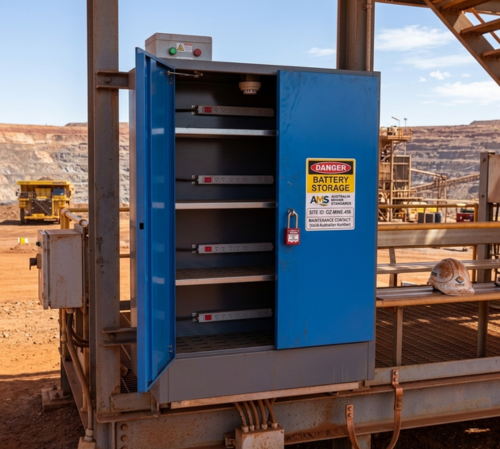
There is currently no single Australian requirement stating that every mine site must install a lithium-ion battery cabinet.
However, Australian WHS obligations require organisations to identify hazards and eliminate or minimise workplace risks so far as is reasonably practicable.
Leading mining operations are therefore moving beyond the question: “Are battery cabinets mandatory?” And asking: “Are we appropriately managing the batteries already being used across our operation?”
A stronger battery storage standard considers the entire battery management process.
Improving lithium-ion battery storage can help mining operations achieve:
For operations managing larger battery inventories, Accumax can help develop a more structured approach incorporating storage, charging, and visual identification management.
The objective is to create an environment that supports the site’s battery management procedures rather than simply adding another piece of equipment.
There is currently no single Australian requirement mandating lithium-ion battery cabinets on every mine site. However, organisations have WHS obligations to identify hazards and eliminate or minimise risks so far as is reasonably practicable. Appropriate battery storage infrastructure may form part of the controls identified through a site-specific risk assessment.
Mine sites are managing increasing numbers of rechargeable batteries across tools, lighting, communications, inspection and other equipment. Greater WHS awareness, insurer scrutiny and proactive risk management are contributing to demand for more structured battery storage and charging environments.
Storage arrangements should consider the battery type, quantity, manufacturer requirements, physical condition, environmental conditions, charging requirements and site-specific risk assessment. Dedicated storage can help create greater consistency and separation from other workplace activities.
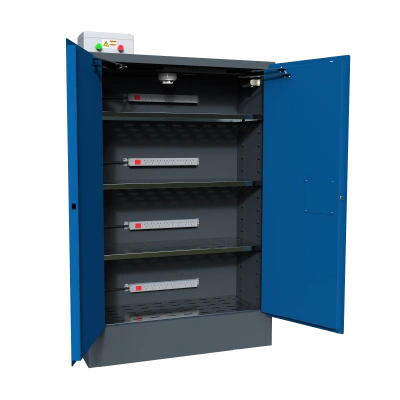
A battery storage cabinet provides a designated location for batteries when they are not being used. A charging cabinet is designed to support batteries while they are being charged. The appropriate solution depends on the application, battery type and site requirements.
Dedicated charging helps sites move away from ad hoc charging on workbenches, shelves and other uncontrolled locations. It can also support clearer procedures, improved organisation and more consistent battery management.
Accumax provides lithium-ion battery storage and charging solutions for mining and industrial workplaces and can help organisations consider how cabinets, charging infrastructure, signage and visual management work together as part of a broader battery management system.