A wheel chock is placed against a tyre to stop a parked vehicle or item of mobile equipment rolling or shifting out of position. The range covers rubber wheel chocks in sizes to suit light vehicles through to heavier plant. Wheel chocks are used across car parks, workshops and loading areas, and form part of mine site traffic management.
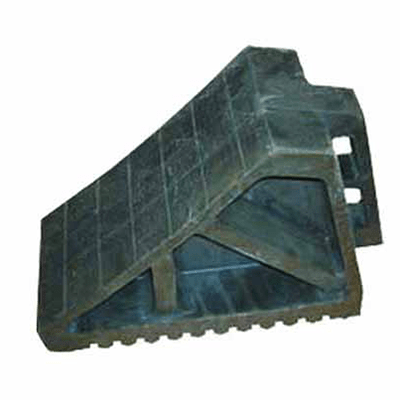
Our wheel chock range gives sites a simple mechanical control to hold a parked vehicle or machine in position. The chock is wedged hard against the tyre on the downhill side. If the park brake releases or the transmission slips, the chock takes the load and the vehicle holds position rather than rolling free into people, plant or structures. Rubber wheel chocks are the most widely used option for general duty across light vehicles, trucks and mobile plant. Rubber grips the ground surface, stands up to weather and fuel exposure, and absorbs impact as the tyre settles against it. Size is usually more critical than material, because a chock has to be tall and deep enough for the tyre diameter it is holding. Larger tyres on heavy equipment need correspondingly larger chocks. When selecting wheel chocks, consider the tyre diameter and the gross weight of the vehicle, the grade it will be parked on, and the ground surface, since a chock holds differently on loose gravel than on sealed concrete. Chocks should be used in pairs where site procedure calls for it, and checked regularly for wear, splitting and loss of grip.
A wheel chock is a wedge placed hard against a tyre to stop a parked vehicle or item of mobile equipment rolling. It is used during loading, unloading, servicing, inspections and whenever equipment sits on a grade.
Rubber is the most common material for general duty wheel chocks. Rubber grips the ground surface, stands up to weather and fuel exposure, and absorbs impact as the tyre settles. Heavier applications may call for other materials.
Match the chock to the tyre diameter and the vehicle’s gross weight. A chock has to be tall and deep enough to hold the tyre it sits against, so larger heavy equipment tyres need correspondingly larger chocks.
This depends on the grade, the vehicle weight and your site procedure. Chocks are commonly used in pairs, either side of the same wheel or on wheels at each end. Follow the procedure set for that vehicle class.
Position the chock hard against the tyre on the downhill side, square to the direction of travel and in full contact with both the tyre and the ground. Clear loose material from the spot before placing it.
No Australian rule names wheel chocks specifically. WHS duties require controlling the risk of unintended vehicle movement, and site procedures or load restraint requirements set when chocking is mandatory.
Yes, provided the chock is sized for the tyre and the machine weight. Light vehicle chocks are not suitable for mining trucks or large mobile plant. Check the rating and dimensions against the equipment.
No. A wheel chock is a secondary control that backs up the park brake rather than replacing it. Apply the park brake, select the correct gear or park position, then chock the wheels as the procedure requires.
Inspect wheel chocks before each use and check them regularly for splitting, chunking, rounded edges and loss of grip on the base. Replace any chock that is cracked, deformed or no longer sits flat against the tyre.
Wheel chocks hold less reliably on gravel, sand and loose surfaces because the base can slide or dig in. Clear loose material first, or park on firmer ground where possible. Assess both the grade and the surface.
Our specialised team is here to assist with custom solutions and multi-site safety rollout.